Flare Gas Recovery System Explained: From Waste Gas to Profitable LNG
In the modern oil and gas industry, flare combustion has long been considered a necessary safety measure. However, with increasingly stringent environmental regulations and ever-rising energy efficiency requirements, flare gas recovery systems are transitioning from “optional equipment” to “core infrastructure.”
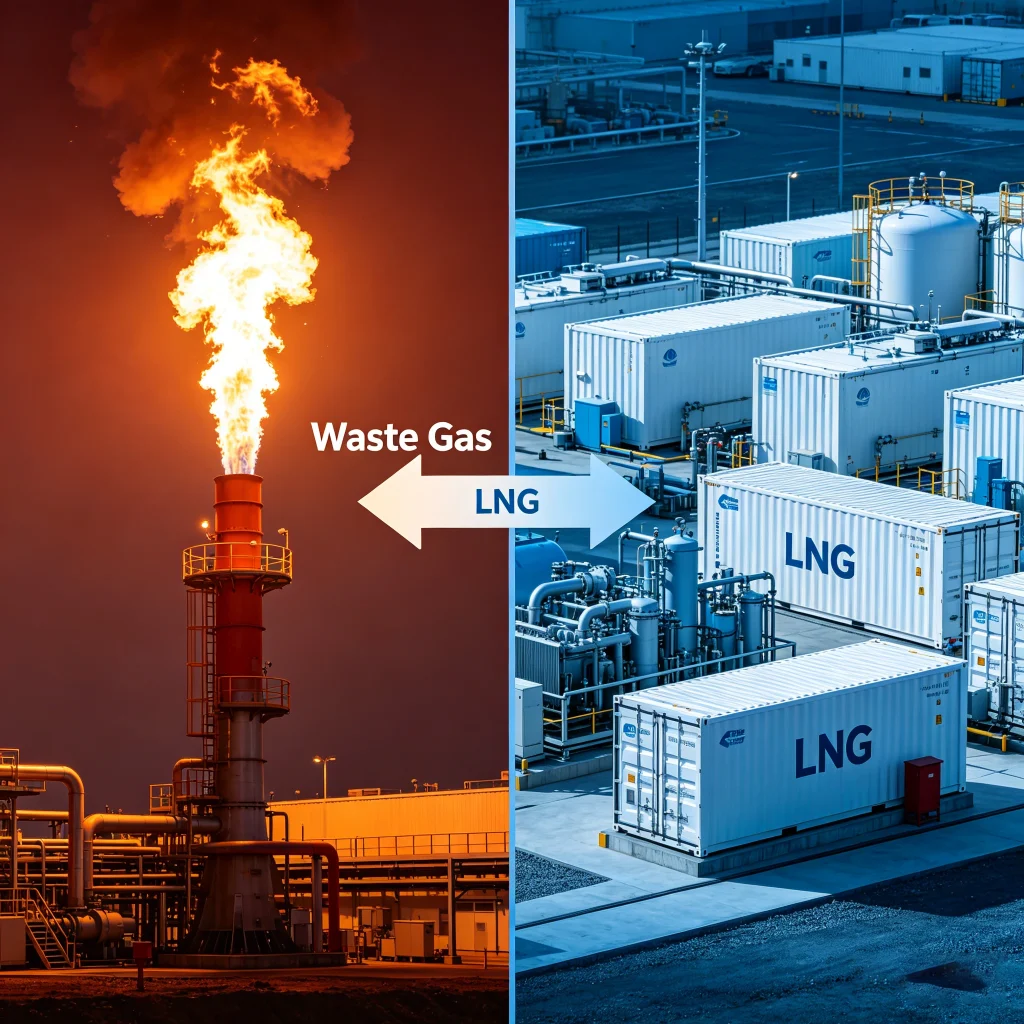
In this article, we will conduct an analysis of the mechanism of operation of gas recovery systems using flares. We will introduce a new concept of gas recovery based on modular liquefaction technology that will facilitate transition from “reduction of emissions” to “profits.”
What Is a Flare Gas Recovery System?
The main point of such a gas recovery system, however, is not only about “gas recovery” but, much more, about the use of an integrated liquefaction system for the conversion of flare gases, that could be burned during the flare process, into LNG – a transportable and tradeable form of energy.
Typically, such gases come from:
- Flare header,
- Separator vent, and
- Safety valve discharge systems.
With gas recovery, it becomes possible to:
- Reduce CO₂ emissions,
- Increase energy efficiency, and
- Generate added economic value.
KAITIANGAS Flare Gas Recovery System Workflow
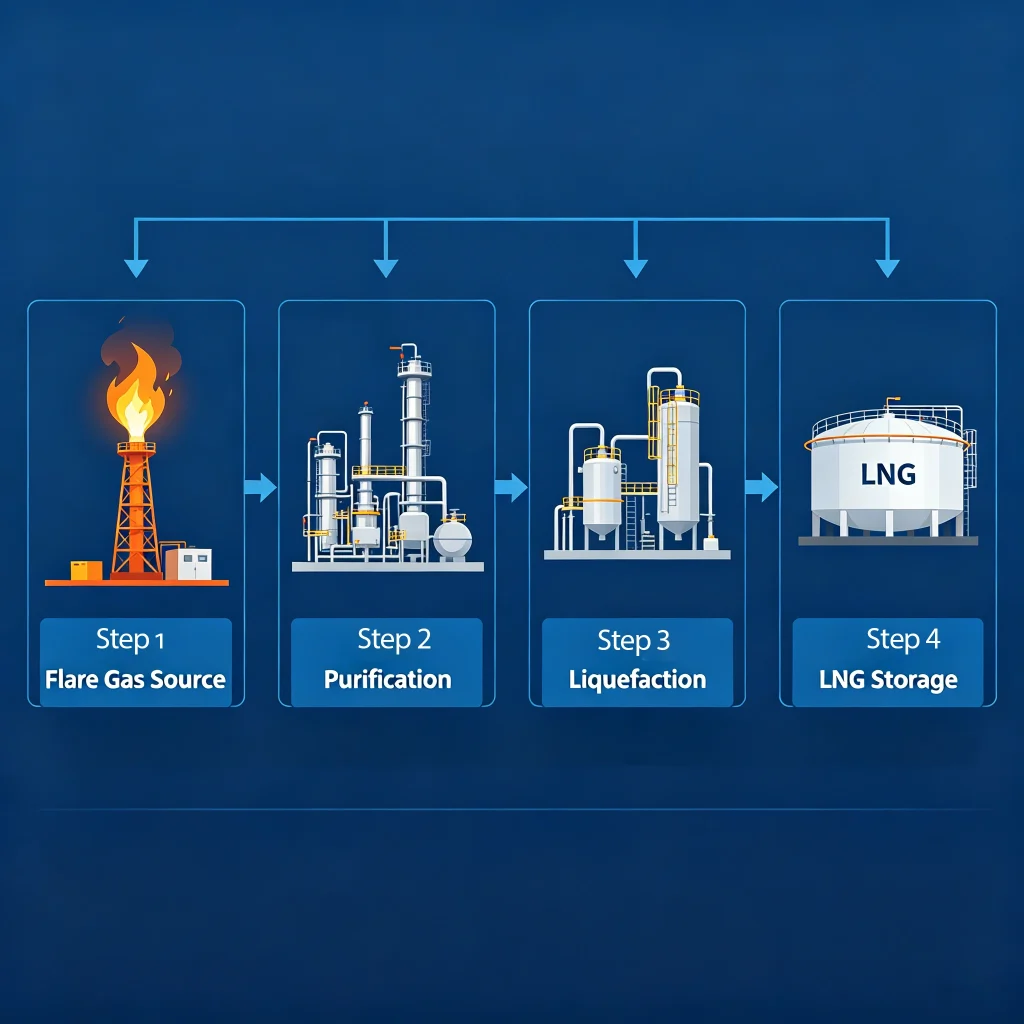
A complete flare gas recovery system typically includes three key stages: gas collection, purification, and resource utilization. In advanced integrated systems, these processes are highly integrated through modular equipment, significantly improving processing efficiency and economic value.
Gas Collection
The system first centrally collects the flare gas from the flare header, separator exhaust, and safety venting gases, introducing combustible gases that would otherwise require combustion into the recovery system to achieve a stable gas supply and reduce direct emissions.
Gas Purification
The separated flare gas is purified of acidic gases like CO2 and H2S, moisture, and any heavy hydrocarbons present. With the help of the purification and regeneration system, the gas can be operated continuously and stably, ensuring an efficient gas supply for its further use.
Gas Reuse
The purified gas can serve either for fuel recycling or for producing energy. With the use of liquefaction, it can be transformed to become LNG (Liquefied Natural Gas), allowing effective storage, transportation, and use in the market.
Detailed Explanation of the Modular Flare Gas Recovery System
KAITIANGAS utilizes a fourth-generation integrated modular liquefaction unit, highly integrating a traditional natural gas liquefaction plant into a single skid-mounted unit, achieving true “plug and play.”
Highly Integrated Design
The system integrates the following core processes:
- Natural Gas Purification
- Liquefaction
- Refrigeration and Compression
All processes are completed within a single unit.
Advantages compared to traditional plants:
- No need for large-scale civil engineering and pipeline investment
- Directly connects to end users or the LNG market
- Significantly shortens the construction cycle
Innovative Natural Gas Purification Process
Utilizing proprietary purification technology, the purification tower achieves:
One-time removal of:
- Acidic gases
- Moisture
- Heavy hydrocarbons
System Features:
- The absorbent is recyclable
- Continuous regeneration via a regeneration tower
- Stable operation, adaptable to complex gas sources
Especially suitable for flare gas with large composition fluctuations
LNG Liquefaction Process
Purified natural gas enters the cold box:
- Heat exchange with mixed refrigerant
- Gas condensation and liquefaction
- LNG enters the cryogenic storage tank after throttling
Mixed Refrigerant Technology (Core Energy Saving Point)
Utilizing an advanced mixed refrigerant refrigeration cycle (MR):
- Refrigerant compression → cooling → throttling and cooling
- Provides the cooling capacity required for liquefaction
- Simultaneously achieves system self-precooling
Advantages:
- Low energy consumption
- High thermal efficiency
- Stable operation
System Core Advantages
| Key Advantage | Technical Description | Customer Value |
| Compact Footprint | Designed in standard container dimensions with a highly integrated structure | Ideal for space-constrained sites, reducing land requirements |
| Fast Installation | Skid-mounted design with quick flange connections and minimal on-site construction | Shortens installation time and enables rapid deployment and relocation |
| Energy Efficient | Utilizes advanced mixed refrigerant technology to optimize energy consumption | Reduces operating costs, with LNG power consumption ≤ 0.6 kWh/Nm³ |
| High Automation | Equipped with a fully automated control system with remote monitoring capability | Minimizes labor requirements, lowers operational costs, and enhances safety |
| Strong Adaptability | Capable of handling fluctuating gas compositions with stable system performance | Suitable for various flare gas conditions, expanding application scenarios |
Performance Specifications
| Parameter | Value |
| Natural Gas Processing Capacity | 20,000 Nm³/day |
| Installed Power | 500 kW (380V) |
| Instrument Air Consumption | 100 Nm³/h |
| LNG Energy Consumption | ≤ 0.6 kWh/Nm³ |
| LNG Output Temperature | ≤ -155°C |
Comparison of Flare Gas Recovery System
| Method | Value Output | Limitations |
| Direct flaring | None | Environmental penalties |
| Compression reuse | Low | Limited demand |
| Power generation | Medium | Infrastructure dependent |
| LNG conversion | High | Requires advanced tech |
From Environmental Protection Equipment to Profit-Making Tool
Flare Gas Recovery Systems are undergoing a fundamental transformation:
- From “Environmental Protection Equipment for Reducing Emissions”
- To “Energy Systems for Creating Value”
Through modular design, integrated liquefaction technology, and intelligent control systems, companies can not only:
- Achieve emission reduction compliance
- Improve energy utilization
More importantly: Transform previously wasted flare gas into high-value LNG products, achieving commercial monetization.